
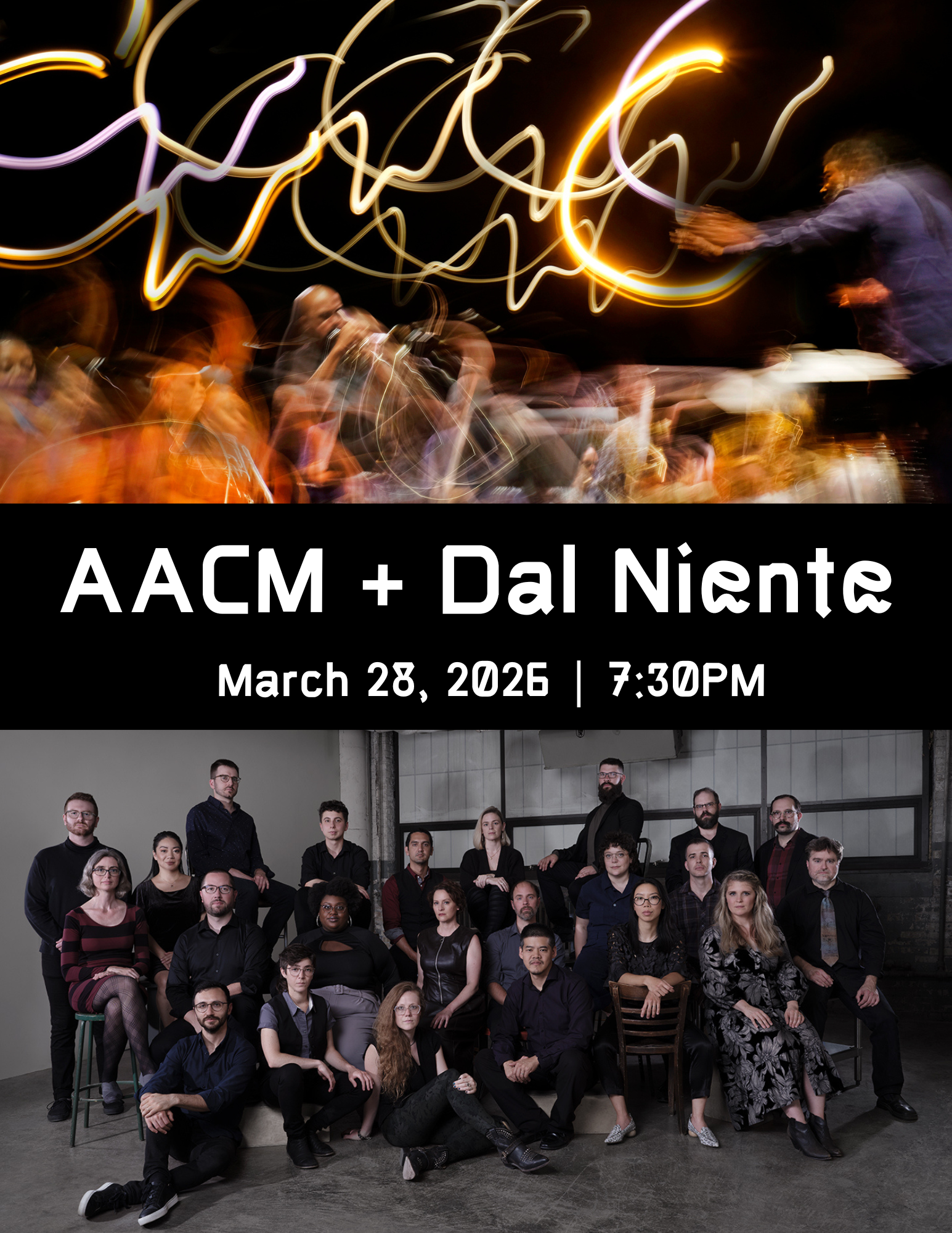
Join us for an historic collaboration between two Chicago powerhouses born on opposite ends of the city: the Association for the Advancement of Creative Musicians and Ensemble Dal Niente. Members of each group will combine into a single super-ensemble, performing new work by Elastic Arts 2026 honoree Renee Baker and more.
$20 - Tickets Available at the Door or HERE
About the AACM:
Since its founding on the virtually all-black South Side of Chicago in 1965, the African American musicians’ collective known as the Association for the Advancement of Creative Musicians (AACM) has played an unusually prominent role in the development of American experimental music. Over more than fifty years of work, AACM members like Muhal Richard Abrams, Mwata Bowden, Anthony Braxton, Kelan Phil Cohran, Douglas R. Ewart, Joseph Jarman, Leroy Jenkins, George Lewis, Nicole Mitchell, Roscoe Mitchell, Amina Claudine Myers, Matana Roberts, Wadada Leo Smith, Henry Threadgill, and Edward Wilkerson, Jr, have explored a wide range of methodologies, processes, and media. AACM musicians developed new and influential ideas about timbre, sound, collectivity, extended technique and instrumentation, performance practice, intermedia, the relationship of improvisation to composition, form, scores, computer music technologies, invented acoustic instruments, installations, and kinetic sculptures– achieving lasting international significance as a crucial part of the history of world musical experimentalism.
In addition to these already ambitious achievements, the collective developed strategies for individual and collective self-production and promotion that both reframed the artist/business relationship and challenged racialized limitations on venues and infrastructure. In a 1973 article, two early AACM members, trumpeter John Shenoy Jackson and cofounder and pianist/composer Muhal Richard Abrams, asserted that “the AACM intends to show how the disadvantaged and the disenfranchised can come together and determine their own strategies for political and economic freedom, thereby determining their own destinies.” This optimistic declaration, based on notions of self-help as fundamental to racial uplift, cultural memory, and spiritual rebirth, was in accord with many other challenges to traditional notions of order and authority that emerged in the wake of the Black Power movement.
The musical influence of the AACM has extended across borders of genre, race, geography, and musical practice, and must be confronted in any nonracialized narration of musical experimentalism that hopes to account for the breakdown of genre definitions and the mobility of practice and method that informs the present-day musical landscape. While accounts of the development of black musicality often draw upon the trope of the singular heroic figure, leaving out the dynamics of networks in articulating notions of cultural and aesthetic formation, the AACM provides a successful example of collective working-class self-help and self-determination; encouragement of difference in viewpoint, aesthetics, ideology, spirituality, and methodologies; and the promulgation of new cooperative, rather than competitive, relationships between artists. Musicologist Ekkehard Jost called attention to both the economic and the aesthetic in summarizing the AACM’s influence. “The significance and the international reputation of the AACM,” Jost maintained, “resulted not only from their effectiveness in organizing, but also, above all, from their musical output, which made the designation AACM something like a guarantee of quality for a creative music of the first rank.”
From George E. Lewis, A Power Stronger Than Itself: The AACM and American Experimental Music (University of Chicago Press, 2008)
About Ensemble Dal Niente:
Ensemble Dal Niente performs, develops, and sustains new and experimental music for small to large chamber ensemble. The group is dedicated to growing relationships with artists, composers, and listeners; advancing distinct and challenging musical voices; and sharing that work with our Chicago, U.S., and international communities.
Dal Niente’s roster of 27 musicians presents an uncommonly broad range of contemporary music. Audiences coming to Dal Niente shows can expect distinctive productions—from fully staged operas to multimedia spectacles to intimate solo performances— that are curated to pique curiosity and connect art, culture, and people.
Since 2004, Ensemble Dal Niente has performed concerts across Europe and the Americas, including appearances at The Metropolitan Museum of Art in NYC; The Foro Internacional de Música Nueva in Mexico City; Radialsystem Berlin, MusicArte Festival in Panama City; The Library of Congress and the Phillips Collection in Washington, D.C.; the Art Institute of Chicago and the Hyde Park Jazz Festival; Walt Disney Concert Hall in Los Angeles; Big Ears Music Festival; The Americas Society; and the Darmstadt Summer Courses in Germany. Dal Niente is the recipient of the 2019 Fromm Music Foundation prize, and was the first-ever ensemble to win the Kranichstein prize for interpretation in 2012. The group has recordings available on the New World, New Amsterdam, New Focus, Navona, Parlour Tapes+, and Carrier labels; has held residencies at The University of Chicago, Harvard University, Stanford University, Brown University, Brandeis University, and Northwestern University, among others; and collaborated with a wide range of composers, from Enno Poppe to George Lewis to Hilda Paredes to Roscoe Mitchell.
The ensemble's name, Dal Niente ("from nothing" in Italian), is a tribute to Helmut Lachenmann's Dal niente (Interieur III), a work that upended traditional conceptions of instrumental technique; and also a reference to the group’s humble beginnings.